
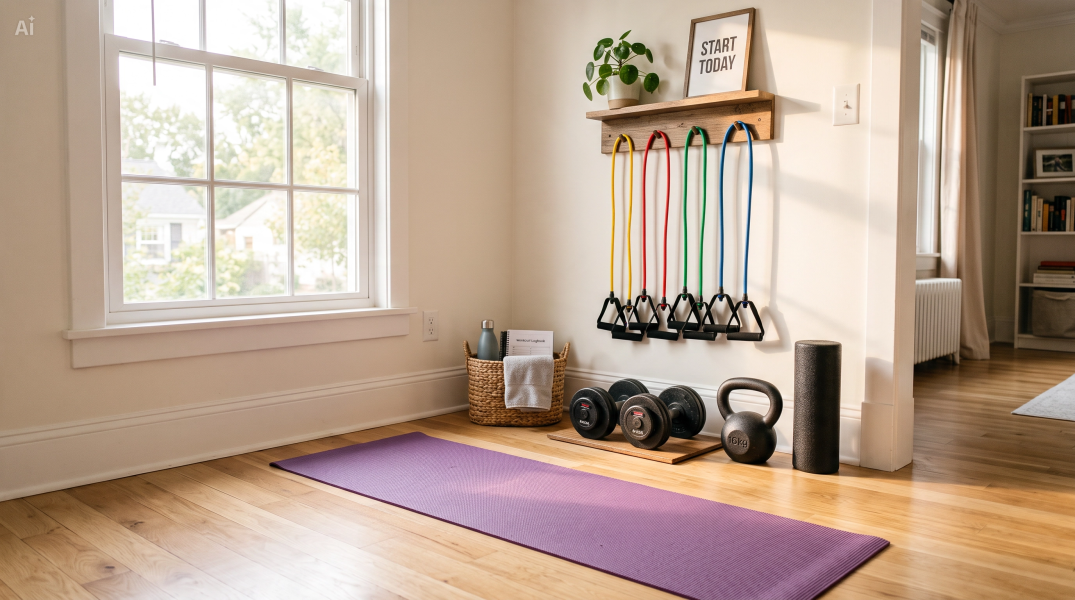
A home gym doesn’t have to be built all at once, and it definitely doesn’t require the most expensive equipment to actually work. Here’s a genuine phased approach — what to buy first, second, and third, with real starter setups at three different budget levels.
The Order That Actually Matters
The single biggest budget mistake we see is buying accessories before the foundation is solid — kettlebells and bands are appealing because they’re cheap, but a wobbly, undersized rack you outgrow in six months costs you more in the long run than spending a bit more upfront on the right foundation. The order that actually protects your money:
- Rack or squat stand — the one piece you genuinely don’t want to buy twice. See our space planning guide before committing to size.
- Barbell — a bar that bends or has poor spin under real load is a false economy.
- Plates — buy incrementally as your strength grows; you don’t need your ceiling weight on day one.
- Flooring — often skipped, but protects everything above it. See our flooring guide.
- Functional/conditioning equipment — kettlebells, adjustable dumbbells, a conditioning machine, added once the foundation is solid.
A Realistic 3-Phase Buying Timeline
Phase 1: The Foundation (Month 1)
A squat stand or entry-level power rack, a barbell, and enough plates to start (typically 200-300lbs total is plenty to begin). This alone supports the core compound lifts — squat, bench, deadlift, overhead press — which cover the majority of what a serious strength program actually needs.
Phase 2: Protection and Comfort (Month 2)
Flooring across your working area, plus a bench if you didn’t include one in Phase 1. This is also a reasonable point to add more plates as your lifts progress past what you started with.
Phase 3: Rounding It Out (Month 3+)
This is where functional and conditioning equipment comes in — an adjustable kettlebell or dumbbell set, and eventually a conditioning machine (rowing machine or air bike) if your budget and space allow. Spreading this over a third phase means you’re not trying to fund everything simultaneously, and you’ll have a better sense of what you actually use by this point.
Three Real Starter Setups by Budget
A squat stand (rather than a full rack), an entry-level barbell, and a modest set of plates (150-200lbs). This genuinely covers the core compound lifts — it won’t have every feature of a premium setup, but it’s a fully functional strength-training foundation.
A proper entry-to-mid-tier power rack (like Titan’s T-3, our best-value rack pick), a quality barbell, a full plate set (300lbs+), a bench, and basic flooring for the working area. This is genuinely a “complete” strength setup most lifters could use indefinitely.
Everything in Tier 2, upgraded to a premium rack and barbell (see our top-rated picks), plus a genuine functional/conditioning addition — an adjustable kettlebell or dumbbell set and a rowing machine or air bike. This is a setup that meaningfully replaces a commercial gym membership for most training goals.
Where Not to Cut Corners, Even on a Tight Budget
Two things are worth spending slightly more on even in Tier 1: the rack’s stability (a wobbly rack is a genuine safety issue, not just an annoyance) and the barbell’s build quality (a bar that bends under moderate load needs replacing anyway, making the “savings” temporary). Everything else — plates, flooring, accessories — is much more reasonable to buy at the budget end and upgrade later if needed.
Frequently Asked Questions
Should I buy used equipment to save money?
Plates and benches are generally safe to buy used, since wear on these is mostly cosmetic. Be more cautious with used barbells (check for bend and spin quality) and racks (check all welds and hardware) — the savings aren’t worth it if the safety-critical components are compromised.
Can I skip the rack entirely to save money?
You can train without one using dumbbells and bodyweight work, but you’ll be unable to safely perform barbell squats or bench press without a spotter. If barbell training matters to your goals, the rack isn’t an optional upgrade — it’s foundational.
Final Word
Building a home gym on a budget is entirely realistic — the key is buying in the right order (foundation first, accessories later) and being honest about which components are worth spending more on versus where it’s fine to start modest and upgrade over time. See our full home gym equipment rankings for specific product picks at every budget level.
This article contains affiliate links. FitnessAdvisor may earn a commission if you purchase through our links, at no extra cost to you. This has no influence on our recommendations. See our affiliate disclosure.
